Living in a Van Full Time: Our Honest Guide
Our little family of three spent 5 years living in a van full time, travelling all over Europe and even into Asia and Africa. Before that we had taken over 6 months to plan, design and self-build our home on wheels to make sure it was exactly matched to our needs.
I can’t tell you how much time we spent agonising over seemingly small decisions. The ones we knew would make an outsized difference to how liveable our van was down the line. And the fact that our daughter was so young (we were already living in the van when she was born) made our choices feel even more consequential.
We meticulously pored over everything from the bed design and storage options to the size of our water tank and the blueprint of our electrical system. And the truth is, even weighing each and every possibility carefully, we ultimately still made mistakes.

That said, all of the time we dedicated to planning was definitely not wasted. Because our van, Casi, took us to places we would never have dreamed of and stood up to every challenge we put to her.
So if you’re wondering whether living in a van full time is right for you, after five years doing just that, we've learned an awful lot about what it really takes to make van life work. From choosing the right layout and managing water and electricity to budgeting, working remotely and travelling with a young child, here's what we'd want to know before setting off.
Is living in a van full time worth it?
For us, 100%. Across five years, our van took us deep into places like Morocco, Turkey, Bulgaria and Bosnia in a way we couldn’t have experienced otherwise. It helped us save enough to buy our apartment in Madrid without a mortgage, and we made lifelong friends in the van life community. It’s not for everyone though, and the rest of this post will help you work out if it’s for you.
Jump to:
- Is living in a van full time worth it?
- What Living in a Van Full Time Is Really Like (the Pros and Cons)
- Planning Your Van Build for Full Time Living
- How Much Does It Cost to Live in a Van Full Time?
- Living in a Van Full Time With Kids
- How to Start Living in a Van Full Time
- Would We Do It Again?
- FAQs About How to Live in a Van Full Time
What Living in a Van Full Time Is Really Like (the Pros and Cons)
As with any lifestyle choice, there are going to be positives and negatives to weigh up. So to help you decide whether this is the right step for you, here are the pros and cons of living in a campervan from my own experience.

Pros
- I think the most obvious positive is the amount of freedom van life gives you. Knowing that you can get up and move somewhere new virtually any time you want is incredibly exciting.
- We had a massively reduced cost of living in the van, particularly because we overwhelmingly prioritised free or extremely cheap park ups. Our setup meant we rarely needed to use campsites. This in turn enabled us to save more money than we’d have otherwise been able to do.
- We loved spending so much time together as a family, particularly in the formative early years of our daughter. We travelled slowly which meant we could experience places more deeply.
- We built an amazing community within van life, both online and in real life. We met lots of fantastic people, many of whom we now consider friends for life.
Cons
- We were really lucky with our van but you do have to factor in unpredictable mechanical costs for things like engine repairs, breakdowns, etc.
- Safety is naturally a big concern when you’re living in a van, both of the van itself with break ins and robberies, and of yourself when you’re parked up in random remote places. Luckily, again, we personally had very few issues in this regard. A good security system helps, and we invested lots of time into finding the right park ups.
- Two adults and a young child in a 2m x 4m tin box was, inevitably, testing at times. However, we always explain to people that we didn’t really live in the van. And what we mean by that is, sure it’s where we cooked, ate and slept, but the vast majority of our time we spent outside in nature or having exciting adventures. The only time it really felt constricting was when the weather didn’t permit us to spend time outside, which leads nicely onto the next con…
- Bad weather is definitely up there as one of the things that I most hated about living in a van. We tried to avoid it as much as possible, but sometimes you just can’t outrun a storm, or a freak windy night will ruin your night’s sleep.
- Sometimes van life can feel like you’re constantly chasing resources. No matter how big your tank, you’ll eventually need to fill up with water. If you install gas, you need to keep an eye on that and some countries like Morocco don’t have the facilities to refill fixed tanks. And even the best designed solar electrical systems still rely on having enough sun (more on that later).
- Campervans require a huge amount of ongoing maintenance. The nature of having a moving home means that things get bumped out of position, components break or fall off, and fighting things like condensation to prevent mould is a constant battle.

If the cons are what’s holding you back, we’ve written a whole post on overcoming the fear of full time van living.
Planning Your Van Build for Full Time Living
I spent months with Sarah meticulously planning every step of the van build because the setup is really important when you’re living in a van. But in the five years we lived in it we were still constantly upgrading and altering things to suit our needs along the way. And everyone we’ve ever met who has lived in a campervan has exactly the same story.
So rather than trying to make sure everything is perfect before you begin your build, I’d recommend accepting that your van will be a continually evolving project. There are some things that it pays to get right from the very start though.
Layout and Storage
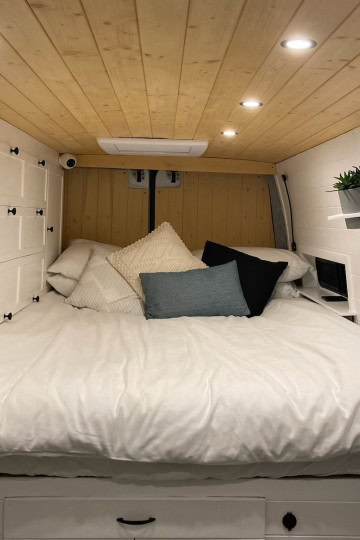
As I mentioned earlier, the time we did spend in the van, we were mostly cooking, eating or sleeping. And timewise, the majority was spent in bed. Because of this it’s incredibly important to decide what setup is best for you, a fixed bed or a convertible one.
Benefits of a fixed bed mean you’re not spending time every morning and evening converting it. Especially when what you probably really want to be doing is getting out on an adventure or collapsing into it after a long day of exploring. You also get a large amount of fixed storage space underneath it, particularly useful for fitting in all your utilities.

On the other hand, a convertible bed is a more flexible use of space and allows your van to be more versatile in its use. You can have a bigger social area for hosting friends, and a well designed one shouldn’t take too long to convert.
A lot of it comes down to how you intend to use the van and your individual personality. We were very clear that we wanted to prioritise spending time outside the van, not inside it so more space was less of a concern.
Plus, we knew that if we had to take a bed down every morning and rebuild it every night, it would probably end up just staying down anyway! So we went for a fixed bed and would do so again. We didn’t want another job to add to the already long list of van life chores.
Here's our best tips on how to sleep in a van.
Water And Toilets
Water is one of the most restricting resources when you’re living in a van full time. Sure, you could get a huge tank that holds enough to last you a couple of weeks or more. But there will be big trade offs when it comes to weight, so depending on the size of your van this may not be feasible. And while it can be the most restricting resource, it’s also generally the most widely and easily available. Many countries have an abundance of free or very cheap places to fill up.
Again, this is a really personal choice and one you’ll need to figure out for yourself. But we opted for a 100 litre tank and could make that last up to a week if we were very careful with it. We were happy with this size tank and found it worked perfectly for us and soon got into the rhythm of planning refills into our travel days.

We know of lots of people who live in vans without a toilet. But for us, for full time van life, we could not have survived without one. Particularly with a young kid.
We started off with a chemical portapotti style toilet, largely because it was way cheaper than the alternatives available at the time. But honestly this is one of our main regrets. It meant we needed to go to an aire or campsite to empty it which was extremely tethering, and this had to be done every few days.
So possibly the biggest upgrade we made to our van was to acquire a composting toilet. I go into all the details in this post on the best toilets for campervans as to why this was the best decision for us and probably will be for you as well.
Power: Batteries, Solar And Charging
Sarah was responsible for designing and installing our entire solar powered electrical setup and made an absolutely incredible job of it. She has a full post on how you can create your own DIY camper electrical system with details on calculating exactly what you need and how to put it together.

This is a real biggie and important to get right. And generally, as mentioned, our system was great. But there is one upgrade we would have made, and that’s to our batteries. We went with AGM lead acid batteries, but these are heavy, take up loads of space, are slow to charge, can only be drained to around 50% or you risk damaging them, and have an average life cycle of 3-5 years.
For a setup like ours a better choice would have been a 320ah lifepo4 battery as these can draw down to around 80%, have more than double the lifespan at 10 years plus, are 50-70% lighter saving you critical weight, and can charge up to three times faster.
Lithium is widely considered to be the better choice all round and though the upfront cost can sometimes be higher, that’s actually paid back over time. They’re a much more sensible long term investment and one we wish we’d made during our van build.

The main reason being that there were occasionally times when our solar system did not get enough sun to fully charge our batteries during the day. This mainly happened when we were in the UK where we’re from. On those occasions we had to find other charging methods and eventually installed an electric hookup for this reason. But it could all have been avoided with lithium batteries and their faster charging and deeper cycling capabilities.
Heating, Ventilation And Gas
Whether you'll need heating comes down to where you’re going to be travelling in your van. For us, we wanted to be ready for all temperatures and weather and so installed a standalone diesel heater. They’re simple to put in, cheap to purchase and extremely efficient, especially in such a small space. We could heat our van from freezing to toasty in less than ten minutes.
We also wanted our van to feel as much like a proper home as possible so a full gas system was really important to us. We opted for a refillable underslung tank with a large capacity that allowed us to power both our water boiler and our cooker and hob for around three months. Definitely a luxury many could live without, but one that felt essential for us as a family so worth considering.

Something we’d recommend regardless of where you plan to spend your time is a decent ventilation system. We had windows, a fan and a rooflight which enabled us to keep cool in hot temperatures as well as avoid condensation. This in particular is really important if you don’t want mould issues!
With a diesel heater and gas on board, a carbon monoxide alarm and smoke alarm are non-negotiable, especially with a little one sleeping inside.
How Much Does It Cost to Live in a Van Full Time?
My honest answer is that it varies hugely from person to person, family to family. It’s also been a while since we lived in Casi, and prices have changed a lot since then. So rather than give you figures that would already be out of date, I’ll run through what you’ll actually spend money on, and the choices that can make the biggest difference to how much.
What You’ll Spend Money On Living in a Van
- Fuel: for most people, this is the biggest variable cost. The further and faster you travel, the more you’ll spend. For us, this was often our biggest monthly expense by far.
- Insurance: you’ll need cover that specifically allows full time living, which usually costs more than standard van insurance. Ours was through a specialist broker. In addition to that, depending on which country you’re travelling through you may need supplementary insurance. This was the case for us in places like Morocco and Bosnia where our policy did not cover.
- Food: budget roughly what you’d spend at home, but for us it was often less. This was because I cooked most of our meals and tried to shop mainly at local markets, buying seasonal products that were readily available rather than automatically searching out the stuff we’d eat at home.
- LPG (Gas): surprisingly little. Our refillable underslung tank powered our water boiler and cooker for around three months at a time and was really a negligible cost.
- Maintenance and repairs: we were lucky with our van, but always kept a buffer for the unexpected. I’d recommend doing the same.
- Phone and internet: essential if you’re working on the road like us. We often spent a fair chunk on this because we had an internet setup in our van and two phones to buy SIM cards and data for.
- Campsites and facilities: for us, these were an occasional cost rather than a regular one so not something we regularly factored in.

What Makes Van Life Cheap or Expensive
I think the biggest factor by far is where you choose to sleep. We prioritised free and very cheap park ups wherever we could, most of which we found using Park4Night. If you rely on campsites, especially in the UK where they can easily set you back £30 to £40 for a basic pitch, your costs will rocket.
How fast you travel matters almost as much. We always prioritise slow travel because we personally prefer it as a way to experience a place in a deeper way. A huge side benefit of moving slowly is that you also use less fuel.
Your build choices make a real difference too. Once we had optimised our setup, solar power, a composting toilet and a large gas tank meant we rarely needed to pay for hook ups or facilities. The more self-sufficient you can be, the cheaper things start to become.

Is Living in a Van Cheaper Than Renting?
For us, yes, by a long way. Obviously you have to take into account the initial cost of purchasing and converting the van, which isn’t insignificant. But with no rent, no mortgage and no household bills, we were able to save far more than we ever could have in a house. In fact, living in the van is the main factor that enabled us to buy our apartment in Madrid outright, without a mortgage.
That said, making it cheap is a choice and we could easily have spent far more by travelling quickly and opting for luxury experiences.
Working and Staying Connected on the Road
One of the questions we get asked most is how we earned money while living in a van full time. If you’re considering getting on the road and need to work while doing it then you’re already one step ahead. But if not, the good news is that there are far more ways to make it work than most people realise.

How We Earned Money While Living in a Van
We’ve worked for ourselves for over a decade now, running this blog, creating content for travel and lifestyle brands, alongside other bits of digital marketing for a wide range of clients. It wasn’t an overnight thing. It took time to build up to a point where it fully supported us. But working for ourselves gave us the flexibility to travel slowly and work around our daughter.
We’re far from unusual, though. Over the years, we’ve met lots of people living in vans who work regular remote jobs, from software developers and designers to admin roles. We’ve also met plenty of fellow bloggers, content creators, photographers and freelancers doing similar things to us. Some people even fund their travels with seasonal work, picking up jobs as they go.
The thing most people we’ve spoken to find the hardest to figure out is routine. It’s less complicated, though definitely not easier, if you have a 9-5 job. For us it was important to split our week into work days and travel days, choosing park ups with good signal when we had work to do and staying put until it was done.
Getting Reliable Internet
If you’re working on the road, a reliable internet connection is non negotiable. We have a full post on our van wifi set up but in simple terms we used a mifi device with a local SIM.

For hopping between countries, an eSIM is an easy way to get data without hunting for a local SIM every time you cross a border and we’d often opt for those. Holafly is the eSIM we've used the most and recommend.
You do have to bear in mind that signal can be patchy in remote areas, so if you’ve got a deadline, plan to be somewhere with good coverage.
Living in a Van Full Time With Kids
Our daughter was born while we were living in the van, so for the first four years of her life, Casi was the only home she knew. People are often surprised by that, but in many ways, van life and young kids go together really well.
The biggest upside for us was time. We got to be fully present for her early years, rather than squeezing family time around work and commutes. And she spent most of her days outdoors, exploring beaches, forests and mountains, and meeting people from all sorts of cultures along the way.

Of course, the van had to evolve as she grew and needed different stuff. Naturally, space got tighter and routine became much more important, so we planned our travel days around naps and always made sure we were parked up long before bedtime.
It wasn’t always easy. As I’ve alluded to already, the hardest part was coping with bad weather when the three of us would all be cooped up inside. Funnily enough, finding other kids to play with was never really an issue. She would regularly make friends with local kids at parks. But the van life community also helped a lot, and we met plenty of other families living on the road.
Honestly, we wouldn’t change it for anything. It was a beautiful and free way for her to spend some of her most formative years and she still talks about the things she remembers and favourite places we visited. Cappadocia with hot air balloons soaring metres above our van is mentioned a lot!

If you’ve got a little one, we’ve written a full guide to van life with a baby, covering everything from sleep to the gear we found essential. And if you’ve got older kids, just know that van life as a family is far more common than you probably imagine.
How to Start Living in a Van Full Time
If you’ve read this far and you’re still excited, here’s how we’d approach it if we were starting again.
- Do a test trip first. Rent or borrow a campervan for at least a week, ideally longer. You’ll learn more about what you need from a van in a week than in months of research. We did not do this! In fact we’d never even stepped foot in a van before we built ours, with hindsight it was not the best idea.
- Downsize before you move in. Living in a van means living with very little, so start decluttering early. It’s far easier to do gradually than in a panic the week before you leave.
- Decide whether to self build or buy converted. Self building is often cheaper and gives you a van built exactly around your needs, but it takes time and skills. Buying a converted van gets you on the road faster, but you’ll pay more and may still need to adapt it. Casi took us over six months to build and to be brutally honest, it’s not something I'd do again. However, I’m so glad that we did it.
- Plan your build around how you’ll actually live. Think about your layout, water, power and heating first, as these are the hardest things to change later.
- Sort your insurance and admin. Find specialist insurance that covers full time living, check whether you’ll need extra cover in certain countries, and work out how you’ll handle post and paperwork without a fixed address.
- Do a shakedown trip. Before you head off long term, spend a few weeks living in your finished van close to home. You’ll quickly find what annoys you, what’s missing and what needs fixing, and it’s much easier to sort while you’re still near friends, family and familiar suppliers. We did a few of these trips and it was extremely helpful to iron out the creases.

Would We Do It Again?
Without hesitation. Committing to full time van life was one of the best decisions we’ve ever made, and it benefitted our family in so many ways.
We travelled to over twenty countries and got to visit places and experience them in a way that just would never have been possible without the van. Living on the road also reaffirmed to us just how little we really need to be happy and live a full life.
You may be wondering why we no longer live in a van if it’s all as great as we say. Unfortunately on our last trip to Spain, we crashed and wrote our Casi off.
This was truly heartbreaking for us as a family as not only did we lose our home in an instant, but we also lost our entire way of life. It was sudden, brutal, and took us a long time to get over. The only saving grace was that we all walked away from the crash physically unharmed.
After a lot of thought, we knew we had to try and reframe it as an opportunity to realise our longheld dream of settling down in Spain. It was something we had always planned to do, just not at that exact time, and so we pivoted and set the wheels in motion earlier than we’d anticipated.
And yet despite how it ended, we’d still choose to do it all over again in a heartbeat.

FAQs About How to Live in a Van Full Time
After a lot of research, we opted for a long wheelbase Mercedes Sprinter. We bought a second hand, former fridge delivery van that had 150,000 miles on the clock. It gave us enough height to stand up and enough length for a fixed bed, which were our two non negotiables.
For us, because we built it, it felt like home really quickly. But it took around six months to really feel like van lifers rather than imposters, and properly settle into a rhythm. The first few weeks can feel chaotic while you work out where everything lives and how to plan water, power and parking. It gets much easier once those things become second nature.
Another of our non negotiables was that we wanted a full shower setup, so we built a wetroom which also housed our toilet. If you don’t want to do this there are loads of clever space saving ways to incorporate a shower into your design, or alternatively, plenty of people simply use gym showers, outdoor solar showers, or rely on campsites. We’ve covered our shower room in detail in our post on building an Easy DIY Camper Van Shower Kit.
There’s no law against living in a van in the UK, but where you can park overnight is a different matter. Many car parks have byelaws or signs banning overnight stays, and wild camping on private land needs the landowner’s permission. You’ll also need a correspondence address for things like insurance and your vehicle registration. Rules vary across England, Scotland and Wales, so always check locally. We found living in a van in the UK unnecessarily difficult and as a result chose to spend most of our time abroad in places where van life is not only easier, but actually welcomed.